
Cellulose vs Fiberglass
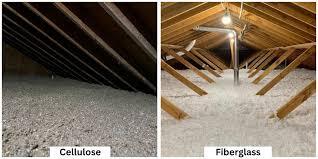
Cellulose vs Fiberglass
The choice between cellulose and fiberglass loose fill insulation depends on whether you prioritize maximum thermal efficiency and air sealing (cellulose) or moisture resistance and long-term stability (fiberglass).
Key Strengths
Cellulose
- Air Sealing: It is approximately 35–40% more effective at reducing air infiltration than fiberglass.
- Sustainability: Made from up to 85% recycled paper (primarily newspaper and cardboard).
- Extreme Temperatures: Unlike fiberglass, which can lose significant R-value in extreme cold, cellulose maintains or even slightly improves its thermal resistance as temperatures drop.
- Pest Resistance: Treated with borates, which naturally repel insects and rodents.
Fiberglass
- Stability: It maintains its original thickness for decades, whereas cellulose can lose 15–25% of its R-value over its lifespan due to settling.
- Moisture Resistance: Fiberglass is non-absorbent and does not rot or support mold growth on its own, making it better for high-humidity areas.
Core Performance Comparison
| Feature | Cellulose (Blown-In) | Fiberglass (Blown-In) |
|---|---|---|
| Air Sealing | Superior; fills small gaps | Poor; allows air movement |
| Settling Rate | High (~20% over time) | Minimal (typically <2%) |
| Soundproofing | Excellent (denser matrix) | Moderate |
| Fire Safety | Class A (treated with borates) | Class A (naturally non-combustible) |